
Concrete vs. Asphalt Driveways: Saratoga Springs Guide
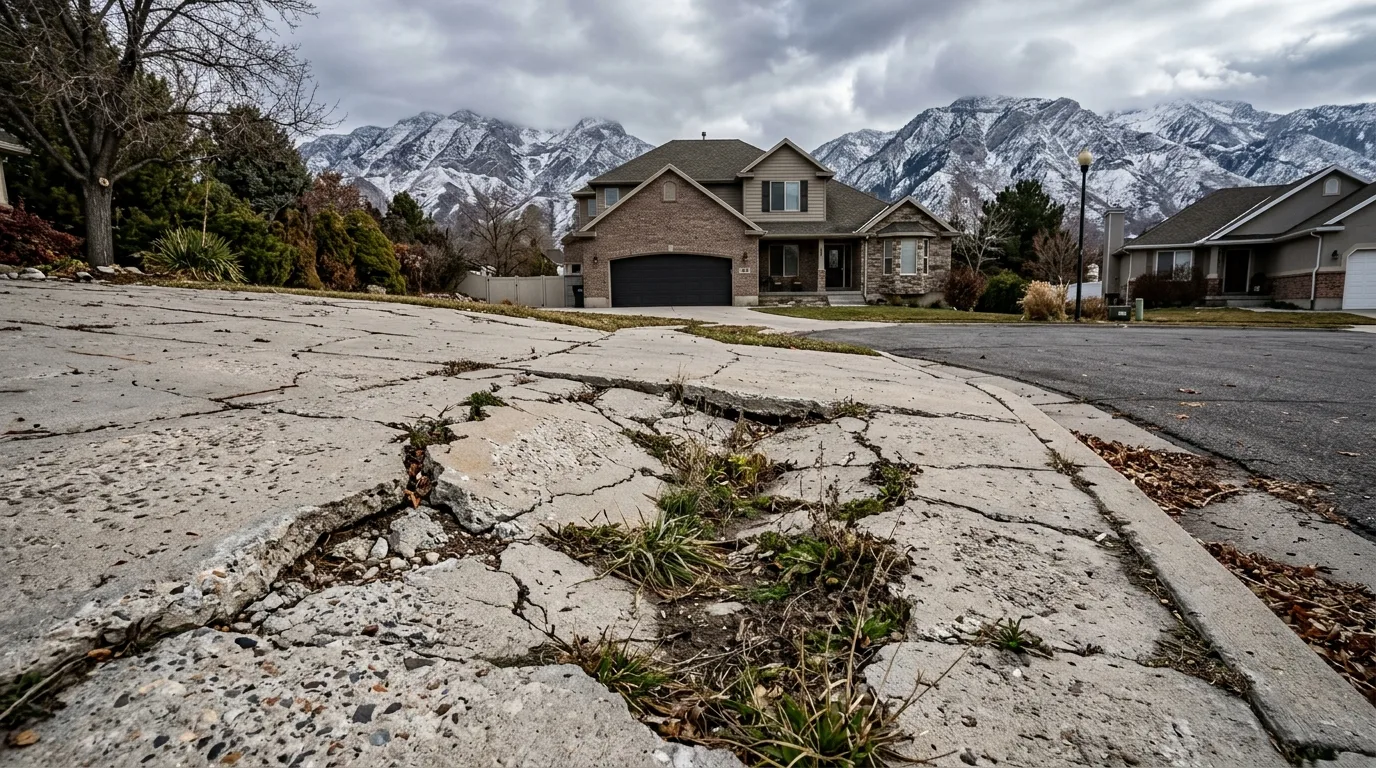
Which driveway material makes more sense for a Saratoga Springs home — concrete or asphalt? It’s a question Utah County homeowners face regularly, and the answer is more nuanced than “concrete lasts longer.” Both materials perform differently under Saratoga Springs’ specific conditions: semi-arid summers that hit 91°F, winters that drop to 17°F, 30+ freeze-thaw cycles per season, and the clay-dominant soils throughout neighborhoods like Fox Hollow and The Crossings. In this post, we cover what each material does well — and what each struggles with — in this specific climate.
Get a Free Concrete Driveway Estimate in Saratoga Springs
We'll help you compare options and spec the right driveway for your property.
Why Material Choice Matters for Saratoga Springs Driveways
The right driveway material in Saratoga Springs, UT isn’t just about preference — it’s about which material holds up to local conditions without requiring constant maintenance or premature replacement. Concrete driveway performance and asphalt performance diverge significantly in freeze-thaw climates, which is exactly what Saratoga Springs delivers November through March.
Homeowners near Saratoga Springs Marina and throughout Utah County often replace deteriorated driveways every 15–20 years when they choose asphalt without accounting for local conditions. Understanding the tradeoffs upfront leads to better decisions and lower lifetime costs.
Concrete Driveways: Strengths and Weaknesses in Saratoga Springs
Strengths:
Freeze-thaw durability is where concrete wins decisively in Saratoga Springs. Air-entrained concrete — the appropriate specification for Utah’s climate — contains microscopic bubbles that accommodate the expansion of freezing water, dramatically reducing surface spalling and cracking. Asphalt does not have this protection.
Heat tolerance matters in Saratoga Springs’ summers. Asphalt softens in high heat, which causes rutting under repeated vehicle loads. Concrete remains rigid at 91°F summer highs — no rutting, no tracking. This is especially relevant for driveways in full sun.
Longevity is concrete’s signature advantage. Properly installed concrete driveways last 30–50 years in Utah County with regular sealing. Asphalt typically needs resurfacing at 15–20 years and full replacement by 25–30 years.
Weaknesses:
Upfront cost is higher for concrete — $5–$8 per sq ft vs. $3–$5 per sq ft for asphalt installed. A 500 sq ft driveway costs roughly $2,500–$4,000 for asphalt vs. $2,500–$4,000 for concrete — the gap narrows after lifecycle costs are factored in.
Crack visibility is higher on concrete. When concrete cracks, the cracks are more visible than in dark asphalt. Properly placed control joints guide cracking to intentional locations, making cracks less visible and structurally benign.
Repair aesthetics — patched concrete rarely matches perfectly, while asphalt repairs blend in better over time.
Asphalt Driveways: Strengths and Weaknesses in Saratoga Springs
Strengths:
Lower upfront cost makes asphalt attractive for budget-constrained homeowners. The installation cost is 30–40% lower than concrete for a comparable surface.
Faster repair visibility cycles — asphalt is more forgiving in the sense that small cracks can be filled with flexible sealant and the repair blends in with the dark surface.
Flexibility in freeze-thaw: asphalt is slightly more flexible than concrete and can tolerate minor subgrade movement without cracking as severely.
Weaknesses:
Heat softening is a real problem in Saratoga Springs’ summers. Asphalt softens in temperatures above 120°F — which blacktop surfaces routinely reach on sunny Saratoga Springs afternoons. This causes rutting in high-traffic areas like turning lanes and garage approaches.
Higher long-term maintenance — asphalt requires seal coating every 3–5 years, crack filling regularly, and resurfacing at 15–20 years. The 30-year total cost of asphalt often exceeds concrete when maintenance is fully accounted for.
Deicing sensitivity — both materials are damaged by some deicing chemicals, but asphalt is generally more sensitive to petroleum-based products and some liquid deicers.
30-Year Cost Comparison for Saratoga Springs
For a 500 sq ft driveway in Saratoga Springs:
Concrete: $2,500–$4,000 installation + sealing every 3 years (~$600 total over 30 years) = $3,100–$4,600 over 30 years
Asphalt: $1,500–$2,500 installation + seal coating every 4 years ($150/application) + resurfacing at year 15 ($1,000) = $3,250–$5,250 over 30 years
Concrete’s lower lifecycle cost is real — and the gap widens for larger driveways. The break-even point for most Saratoga Springs homeowners is around year 8–12, after which concrete’s lower maintenance cost offsets the higher upfront investment.
Which Is Right for Your Saratoga Springs Home?
Choose concrete if: you plan to stay in the home long-term, want lower maintenance, value the heat tolerance in Utah summers, or have a larger driveway where lifecycle savings are substantial.
Consider asphalt if: you need a lower upfront cost and are comfortable with the ongoing maintenance requirements, or you’re planning to sell the home within 10 years.
For most Saratoga Springs homeowners, concrete driveway installation delivers better value over the life of the home. The climate conditions — particularly freeze-thaw cycling and summer heat — favor concrete’s material properties.
Practical Uses for Each Material
- Full driveway replacement: Concrete wins on a 30-year lifecycle cost in Saratoga Springs’ climate.
- Short-term budget replacement: Asphalt offers lower upfront cost if budget is the primary constraint.
- Decorative upgrade: Concrete is the clear choice — stamped and colored concrete options don’t exist in asphalt.
- RV pad and heavy vehicle areas: Concrete’s rigidity handles heavy loads without rutting.
Frequently Asked Questions
Is concrete or asphalt better for Saratoga Springs winters?
Concrete is better for Saratoga Springs winters when properly specified with air entrainment and control joints. Asphalt is slightly more flexible but softens in summer heat and has a shorter lifespan. The freeze-thaw performance advantage goes to properly spec’d concrete.
How much more does concrete cost than asphalt in Saratoga Springs?
Concrete costs roughly $2–$3 more per square foot installed than asphalt in Utah County. On a 500 sq ft driveway, that’s approximately $1,000–$1,500 more upfront. The gap typically reverses on a 15–20 year timeline when maintenance costs are included.
How long does concrete last vs. asphalt in Saratoga Springs?
Concrete lasts 30–50 years; asphalt typically needs resurfacing at 15–20 years and full replacement at 25–30. For homeowners planning to stay long-term, concrete’s lifespan advantage makes it the stronger financial choice for Saratoga Springs properties.
Compare Concrete Options for Your Saratoga Springs Driveway
Call Saratoga Springs Concrete Pros at (888) 376-0955 for an honest comparison and free estimate. Serving Saratoga Springs and Utah County.
Related: