
RV Pad Concrete in Saratoga Springs, UT: Complete Guide
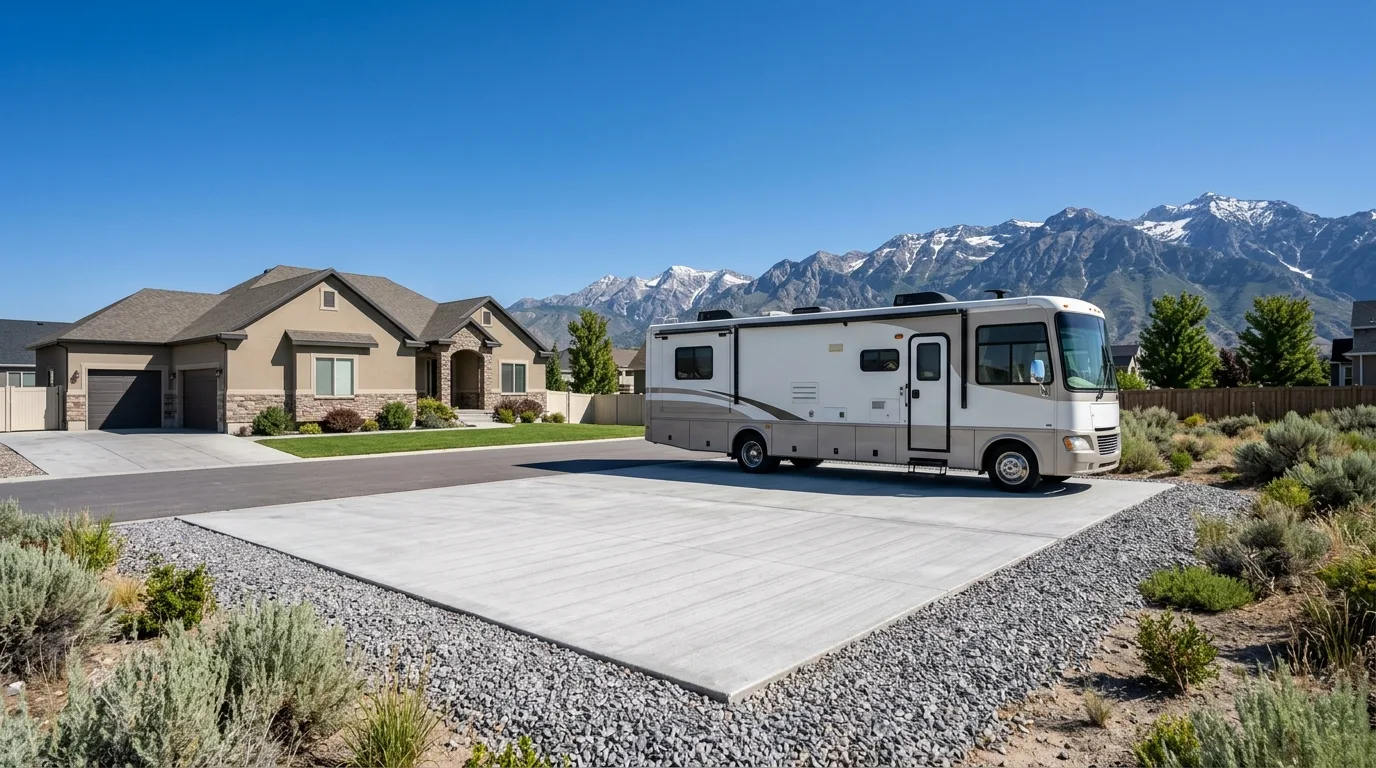
Saratoga Springs has one of the highest RV ownership rates in Utah County — families who use Utah Lake for boating and camping, off-road enthusiasts heading to the West Desert, and homeowners who simply want a clean, durable surface for storing their RV or boat trailer. A concrete RV pad is the most practical long-term solution: no asphalt that softens under a 20,000-pound motorhome in July, no gravel that tracks into the garage, and no grass that turns to mud every spring. This guide covers everything you need to know about RV pad concrete installation in Saratoga Springs.
Get a Free RV Pad Concrete Estimate in Saratoga Springs
We'll spec the right pad for your vehicle type and soil conditions. Call (888) 376-0955.
Why Concrete RV Pads in Saratoga Springs, UT Are the Right Choice
Concrete RV pad installation in Saratoga Springs outperforms asphalt and gravel alternatives in three critical ways. First, concrete is rigid — it doesn’t soften in Utah’s summer heat or rut under repeated heavy vehicle loads the way asphalt does. Second, concrete is permanent — a properly installed pad on compacted road base in Saratoga Springs lasts 30–50 years without resurfacing. Third, concrete drains cleanly and provides a level, stable surface for vehicle leveling systems.
The one significant challenge for RV pads in Saratoga Springs is the same as for all concrete here: Utah County’s clay soils require more substantial base preparation than sandy or loam soil conditions would. Without adequate road base, the clay expansion and contraction will crack and heave the pad within a few years.
RV Pad Size Requirements
Standard RV pad dimensions depend on the vehicle class:
- Class A or Class C motorhome (30–45 ft): Minimum 12 feet wide × 40 feet long; 14 feet wide is recommended for slide-out clearance
- Fifth-wheel trailer (28–40 ft): Minimum 12 feet wide × 35 feet long; allow extra length for the hitch overhang
- Travel trailer (18–28 ft): 10 feet wide × 28 feet long for shorter trailers; 12 × 35 for longer models
- Boat trailer: Varies by boat size; 10 × 25 feet handles most recreational boats
When sizing an RV pad in Saratoga Springs, account for slide-out extensions on both sides, hookup service access (electrical, water, sewer if applicable), and turnaround or parking maneuvering space. A pad that’s too narrow creates scraping damage to landscaping or vehicles with each parking maneuver.
Concrete Thickness and Reinforcement
RV pad concrete thickness in Saratoga Springs should be a minimum of 5 inches for Class B vans and smaller trailers, and 6 inches for Class A motorhomes, fifth wheels, and any vehicle over 15,000 lbs GVW. Standard residential driveway specs (4 inches) are undersized for Class A motorhomes — the increased pad thickness distributes the load adequately and prevents flex cracking under heavy vehicle weight.
Reinforcement for RV pads in Utah County typically uses fiber mesh throughout the mix (for crack resistance) plus rebar (#4 rebar on 18-inch centers) for the added load capacity. Wire mesh alone is insufficient for Class A motorhome pads — rebar provides the structural reinforcement needed to resist vehicle point loads.
Base Preparation for Saratoga Springs Clay Soils
This is the most important part of the entire RV pad project on a Saratoga Springs lot. The process:
- Excavation — dig down a minimum of 8–10 inches below finish grade for a 6-inch pad; deeper if soil conditions require
- Subgrade compaction — compact the native clay with a plate compactor or jumping jack before placing base
- Road base installation — 4–6 inches of compacted Class II road base (crushed gravel); this layer is the stability layer that prevents clay movement from reaching the slab
- Vapor barrier — a 6-mil poly vapor barrier reduces moisture migration from the clay into the concrete from below
- Rebar and forming — set forms, place rebar grid, check grade
- Pour and finish — air-entrained concrete at 4,000 psi minimum, broom-finished for traction
Permits for RV Pads in Saratoga Springs
Freestanding RV pads at grade generally do not require a building permit in Saratoga Springs. However, RV pads connected to the home’s electrical system (for shore power hookups), pads with utility connections, or pads within required setback areas may trigger permit requirements. Check with the Saratoga Springs Building Department before adding utility connections, and verify setback requirements with your property survey.
HOA restrictions are common in Saratoga Springs’ master-planned communities — Fox Hollow, Pelican Point, and Talon’s Cove all have HOAs that may regulate RV storage on residential lots. Confirm HOA approval before investing in an RV pad.
Cost of RV Pad Concrete in Saratoga Springs
A standard 12-foot × 40-foot (480 sq ft) concrete RV pad in Saratoga Springs typically costs:
- 5-inch pad with fiber mesh: $2,400–$4,300 (at $5–$9 per sq ft)
- 6-inch pad with rebar: $3,840–$5,760 (at $8–$12 per sq ft for heavier spec)
- Additional costs: Site prep and grading if needed; electrical conduit stub-out for shore power; drainage modifications
Compare this to asphalt pads, which cost less upfront but require resurfacing every 15 years and are prone to rutting under heavy Class A motorhome loads in Utah’s summer heat.
Types of RV Pad Finishes
- Broom finish — most common; provides slip resistance and is easy to clean; excellent for Saratoga Springs’ all-weather conditions
- Exposed aggregate — decorative option that provides texture and visual interest; appropriate for pads visible from the street
- Stamped concrete border — some homeowners add a decorative stamped border to the RV pad while keeping the field in plain broom finish for cost efficiency
Frequently Asked Questions
How much does an RV pad cost in Saratoga Springs?
A 480 sq ft concrete RV pad (12 × 40 feet) typically costs $2,400–$5,760 in Saratoga Springs depending on slab thickness, reinforcement, and site conditions. Clay soil prep adds $500–$1,500 depending on how much base work is needed on your specific lot.
Do I need a permit for an RV pad in Saratoga Springs?
Freestanding RV pads at grade generally don’t require a building permit in Saratoga Springs. Utility connections (electrical for shore power) may require a separate electrical permit. Always verify setback requirements and HOA restrictions before installation.
How thick should an RV pad be for a Class A motorhome?
6-inch minimum concrete thickness for Class A motorhomes in Saratoga Springs, with rebar reinforcement on 18-inch centers. This handles the 20,000–30,000 lb GVW typical of larger Class A coaches without cracking under concentrated wheel loads.
Get a Free RV Pad Estimate in Saratoga Springs
We spec every RV pad for your vehicle class and soil conditions. Call (888) 376-0955.
Related: